Departments
Intermediate Japanese - Free Online Course

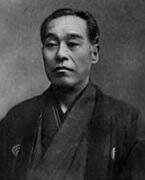
FUKUZAWA YUKICHI
福澤諭吉
(1835 – 1901)
A writer, philosopher, and advocate of Westernization, Fukuzawa Yukichi was one of the most influential figures of the Meiji Era (1868-1901). Fukuzawa’s life included many achievements. He founded Keio University, and wrote over 100 books. Fukuzawa was also an original thinker. His enthusiasm for Westernization was not limited to technology and gadgets. He was intensely interested in importing democratic principles.
The Son of a Poor Samurai
Fukuzawa was born to a samurai household in Kyushu. The family had seen better days; despite their samurai status they were actually quite poor. Moreover, Fukuzawa was a younger son, so under the rules of primogeniture his inheritance would be minimal. He therefore decided not to rely on his noble status; he would create his own destiny.
While still a young man, he moved to the city of Nagasaki where he could learn the Dutch language. Dutch merchants had long dominated European trade with Japan; and Dutch was then the language that the Japanese used to learn about the West. A few years later, Fukuzawa discovered that English was rising as a world language, so he mastered it as well.
Trips to Europe and America
Fukuzawa parlayed his language skills into opportunities to accompany some Japanese delegations overseas. He visited both Europe and America during the 1860s. His subsequent writings reveal his fascination with the countries he visited. Many of his reactions highlight the contrast between Japan and the West in the nineteenth century. In his autobiography, Fukuzawa recounts his surprise at the fact that broken iron tools and old nails were discarded as trash in the United States. In Japan these would have been far too valuable to throw away.
Most Japanese who traveled abroad during this period were obsessed with Western machinery. Fukuzawa dutifully looked at gadgets while abroad, but he was more interested in how Western institutions functioned. He wanted to know the nuts and bolts of how banks, hospitals, and government agencies served the public in America and Europe.
Fukuzawa Becomes a Writer
Fukuzawa grasped the essential points of American democracy, and the wider concept of individual rights as it was understood throughout most of the West by the mid-1800s. He is credited with introducing a variety of abstract Western words into the Japanese language—from the fields of philosophy, civics, and economics. He often struggled to “invent” a Japanese word for these concepts when no equivalent yet existed. The ideas he championed include equal rights for women, representative government, and personal liberty.
Fukuzawa’s first major written work was Conditions of the West, a three-volume series that he published between 1866 and 1870. These books were soon followed by others. The term “Fukuzawa books” became synonymous with Western learning.
Fukuzawa’s Attitudes about Japan and the West
Fukuzawa’s attitudes about his own country should not be misunderstood. On one hand, he did not flinch from exposing aspects of Japan that he believed to be backward. In An Outline of a Theory of Civilization, he describes Japan as “semi-civilized,” like China or the nations of the Middle East—and definitely inferior to America and Europe in the areas of culture, government, and science. At the same time, he was a devoted patriot. He asserted that Japan could overcome its weaknesses and deal with the nations of the West as equals.
While never wavering from his calls for Japan’s modernization, in his later years Fukuzawa became convinced that the West did not practice what it preached. He was angered by the West’s imperialist land grabs in Asia, and the unequal treatment of non-whites in most Western countries. The behavior of the many Westerners in his midst also disillusioned him. He lamented that the foreign merchants and sailors who visited Japan were prone to drunkenness, dishonesty, and violent behavior.